
For the 39th edition of the Houston Art Car Parade, Untitled Art teamed up with cultural partner The Orange Show Center for Visionary Art, Bayou Graphics, and sponsors City Place and Lexus to produce a pair of art cars by Los Angeles–based artists Aryo Toh Djojo and Mario Ayala. The latter arrives in Houston with added momentum, his exhibition Seven Vans, currently on view at the Contemporary Arts Museum Houston, runs through June 21.
Last year Untitled Art relied on local sources and makers: images from the Houston. It’s Worth It. campaign collaged on a late model sedan by supporters of Texas Children's Hospital. But for year two we thought we’d dig a little deeper into the fair’s automotive ethos by enlisting two painters who readily reference car culture in their practices. In the parade, Toh Djojo and Ayala’s work took on a different charge as these tropes moved through Houston’s streets as art cars. After the vehicles alight in the city through the spring and summer, they’ll return to the Untitled Art fold this fall at the second edition of the fair, which runs October 2-4, inside the George R. Brown Convention Center. There, the cars will be reframed as sculptural objects, ones that have been road-tested and contextually reprogrammed.

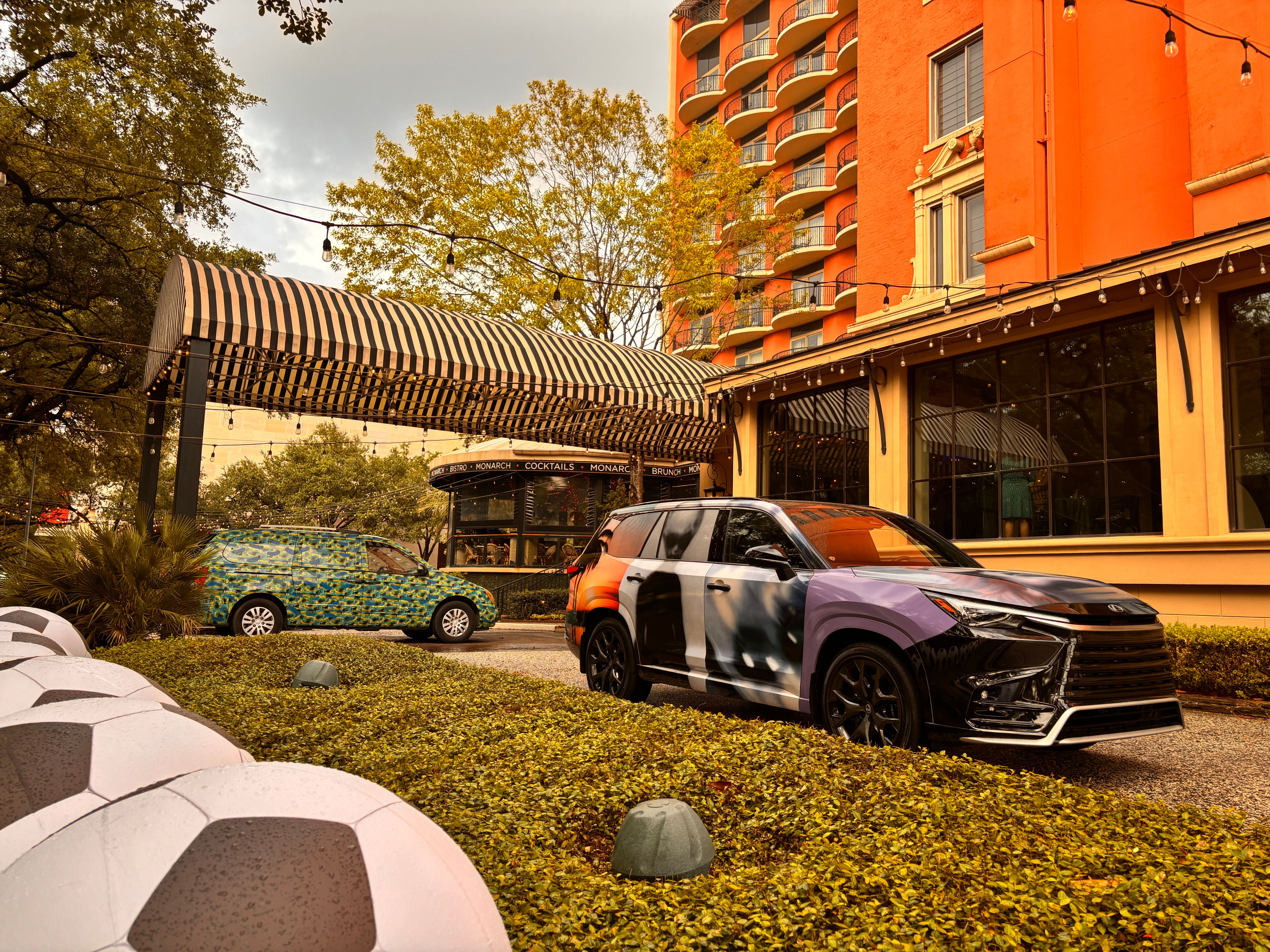
Take Aryo Toh Djojo’s Green Light. Referencing the long tail of California car culture, UFOlogy lore, the deadpan textuality of Ed Ruscha, and even a memento mori lineage that runs back to Vincent van Gogh, for the parade the artist’s airbrush creations were transformed into a mobile mise-en-scène (or rolling assemblage) that collapsed the uncanny juxtapositions of his gallery installations into a single, continuous surface.
Sprawled across the body panels of a 2026 Lexus TX, the composition read like a fractured storyboard of West Coast mythologies and private iconographies: a 1970s sci-fi model stares skyward from the hood, mirrored lenses catching a punishing sun; a jaundiced skyscape is punctured by a hovering UFO near the driver-side wheel; and ghosted freeway traffic bleeds across the doors in a hazy afterimage. Toward the rear, visitors from space collide with a softened, almost elegiac streetscape of palm trees, while a monochrome lavender quarter panel lands a wry citation of Van Gogh’s iconic vanitas painting Skull of a Skeleton with Burning Cigarette… The sequence resolves in a black-and-white text-based work that triangulates between Bruce Conner’s filmic montages and Ruscha’s laconic cool.
“It’s a little LA noir, a little sci-fi, and it may seem fatalistic at first glance,” says Toh Djojo, who is preparing for a solo show at Perrotin in New York this fall. “But it’s really about looking forward to the road ahead.”

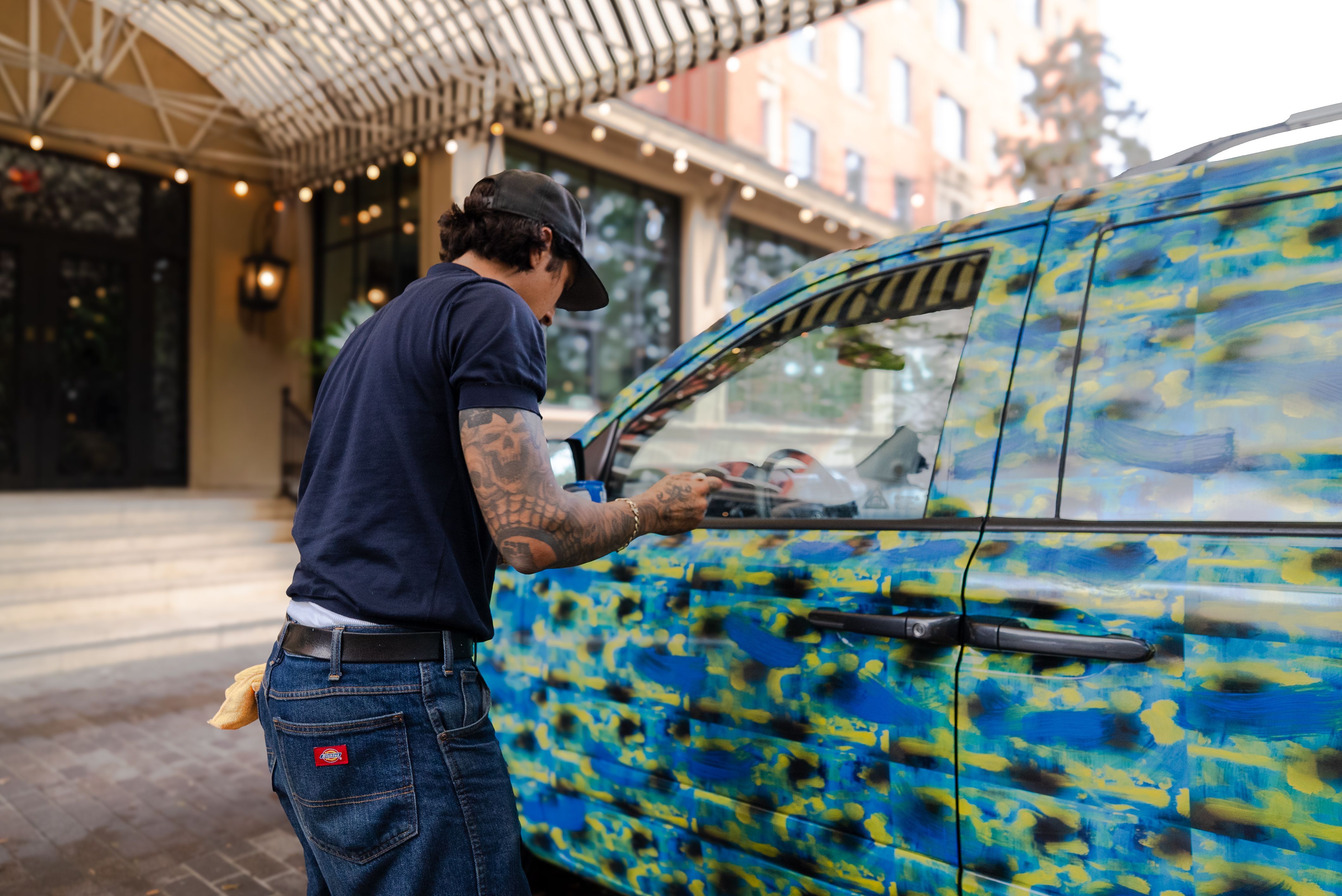

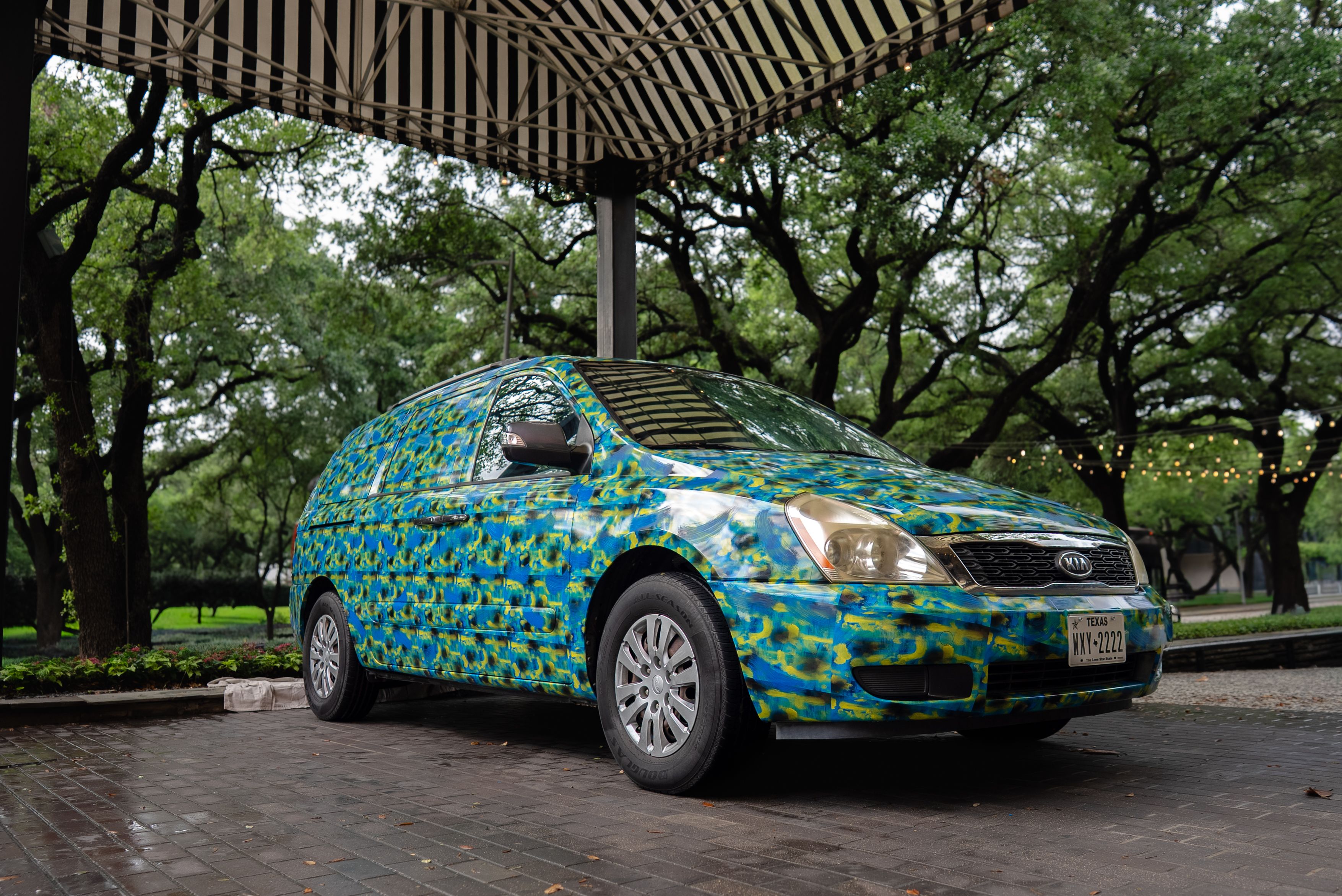
For Ayala, whose meticulous trompe-l’œil airbrush technique draws equally from Mexican muralism, tattoo culture, and the semiotics of truck stops, the art car brief became an opportunity to literalize the logic of Seven Vans. If that exhibition treats the van as both subject and support, here he pushes it into circulation.
Working from a found photograph of a hand-painted minivan, Ayala digitized and tiled the image, compressing its rough-hewn brushwork into a repeatable pattern mapped onto a 2012 Kia Sedona. The surface was first flattened via a wrap produced with Bayou Graphics, then reactivated through hand-rendered passages in the lead-up to the parade as an intentional oscillation between the digital, the industrial, and the artisanal. Titled Dazzle, the project nods to the disorienting camouflage strategies of World War I and World War II, where dazzle ships were painted in clashing geometric patterns—zigzags, stripes, spirals—to scramble perception rather than evade it. It’s a language that has since been absorbed into the art-historical bloodstream, resurfacing everywhere from modernist abstraction to the high-gloss theatrics of Jeff Koons’s yacht for collector Dakis Joannou.
“Aryo and Mario really showed up and turned the icons of their practices into moving objects that were as conceptually rigorous as they were playful,” says Michael Slenske, director of Untitled Art, Houston. “They each generated such a great response at the parade, so I can’t wait for them to come home to the fair this fall, where everyone can see them for the dynamic sculptures that they are.”