

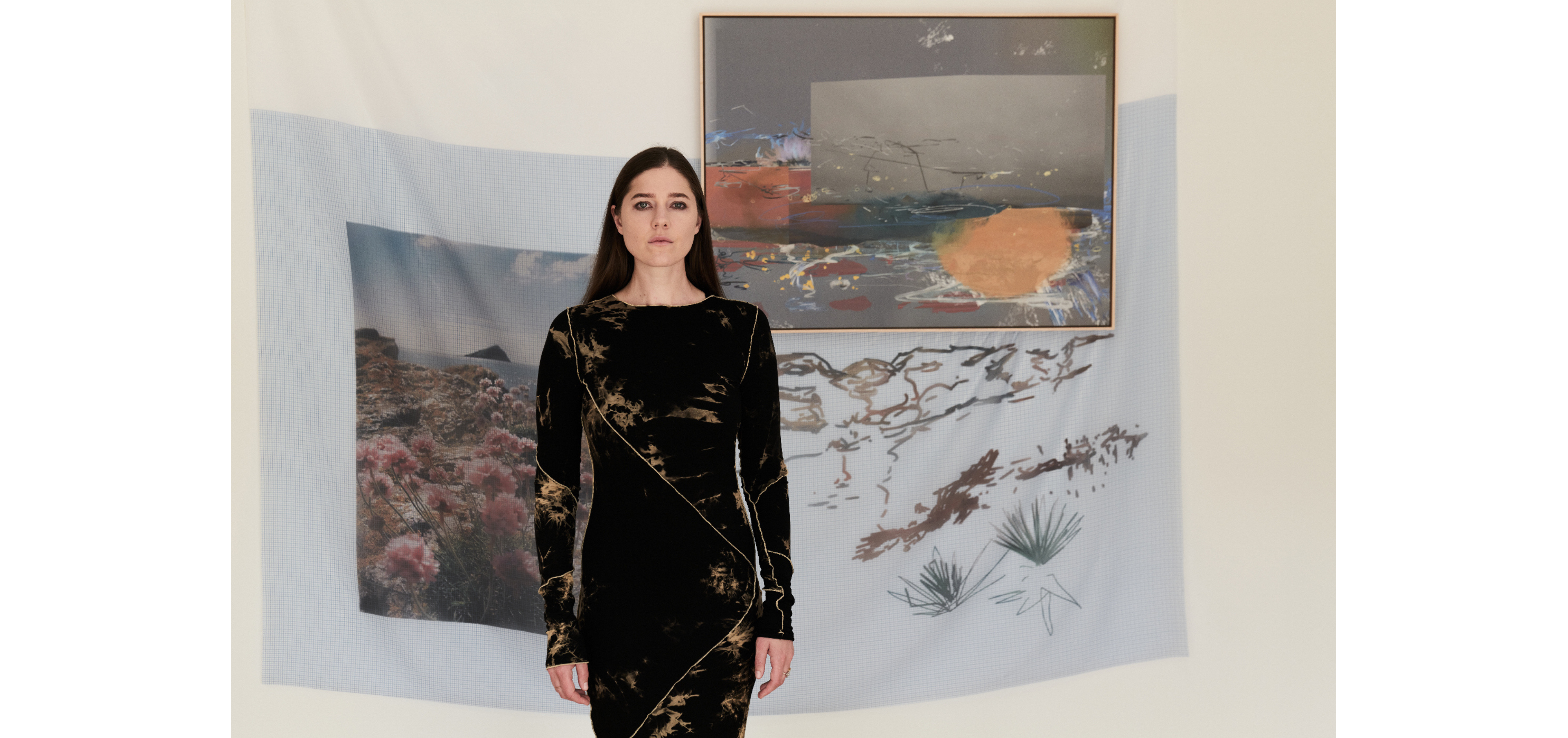
When Petra Cortright’s life was upended early this year due to Los Angeles’ fires, she found an outlet in her work, and—for the first time—curating. Now in Miami Beach, for Untitled Art’s Artist Spotlight sector, she debuts a selection of artists, many working on new digital frontiers or outside the fringes of the art world.
When we meet ahead of the fair, Petra Cortright leads me to the back of a green, tree-lined courtyard in the Simchowitz Gallery's Hill House in Pasadena, where she’s preparing her curatorial debut for Untitled Art’s Artist Spotlight initiative. It’s mid-November, but summer in Los Angeles fades slowly, and today offers the final remnants before weeks of rain. She is dressed in a loose white T-shirt and jeans, bare-faced save for a swipe of mascara, her long, light brown hair still air-drying in the sun—her face unobscured now by the sunglasses, red lipstick, and glitchy webcam effects that marked her early video art days. She sits across from me with her laptop open, scrolling for references of the artists that she has selected. “Everyone knows that the Internet has been the biggest change in our world over the past 30 years, so it's so weird to me that the art world has been slow to adopt it,” says the artist, who sees her position as an opportunity to hold a mirror to the world.
The relationship between art and digital mediums has long been framed as a charged one, but Cortright sees this way of thinking as counter-intuitive in a world where screens invade virtually everyone’s day-to-day life. “I'm always pretty quick to reject any kind of black-and-white or good-and-evil thinking. It’s not helpful in art, and it's not helpful in life,” she says. “I'm much more interested in what happens in the netherworld in-between.” Over the years, she has kept track of the artists who share her sentiment. Now many appear in her spotlight section.
She cites Auriea Harvey, of New York-based Heft gallery, who creates worlds that straddle the physical and virtual—”she's been in the game for a very long time,” she says. Christiane Peschek of Istanbul gallery, SANATORIUM, whose paintings she gravitated toward due to their obscured, blurry, almost cyber effect. And Meg Cranston, known for investigating cultural meaning and aesthetics via her conceptual sculptures and paintings, whose work will be shown with Meliksetian | Briggs (Dallas and Los Angeles). “I just like to see people doing interesting things, using technology as tools,” she muses.
Yet while she has long-followed many of these artist’s trajectories, working on the other side of and actually showcasing others’ work is a first. “It's a very new process to me,” she says of the curatorial process, a departure from her usual solo work at her computer. Behind her, an assortment of tall cacti jut out around a long, rectangular pool in what has all the makings of an oasis in the middle of mountainside suburbia. “Landscaping is my true passion,” she tells me as we make our way past a row of stout, bushy palm trees, revealing that she is the one behind the greenery that now dots and dashes the property. In a sense, it’s like curating, I propose: you begin with a clear vision, then assemble elements whose similarities and differences bring it to life.
Her choice of artists follows a similar principle. There is Sho Shibuya, whose meditative paintings over New York Times newspapers, will be shown with New York gallery Bienvenu Steinberg & C. Montreal’s Wishbone gallery will present Florencia Rothschild’s work, in which the body’s physicality is transposed onto ceramic forms. Giuseppe Lo Schiavo will bring his speculative futures to Milan-based Plan X’s booth. As she sees it, they all can be traced back to her interest in those whose work goes against the grain. “I like self-taught outsider artists,” she explains of one directive she gave herself, citing her own collection of paintings on wood sourced from Montgomery, Alabama, as well as works from San Francisco’s Creativity Explored, a nonprofit gallery and studio space for artists with developmental disabilities to make and sell their work. Then there is the technology element. “I've been pushing screens as much as possible,” she says. “Everyone's on their screens all day, and then you go to these art fairs and you just don't see even one screen. Isn't art supposed to be a mirror of our life?”
In many ways, the overlap between the two categories is personal: “I feel like I'm outside of the art world… I came at it from the Internet,” she muses. Cortright, whose work includes self-portrait webcam videos and Photoshop-based paintings learned over countless hours online, grew up on the Internet in a family of artists. Over two decades ago, she found her voice through video art. Then she expanded into glitchy, ethereal digital images that metabolize found and original photographs into painterly fragmented, fantastical landscapes, flora and fauna both of this world and beyond it. The works are larger in scale now than they initially were. And the technology is more all-inclusive, too.
“It’s just a tool,” she offers on the hot-button topic of AI. “And there will always be another tool.” It’s only natural then that there is a virtual reality interpretation of the Artist Spotlight section, designed by Cortright in partnership with Vortic. She pulls up an image on her laptop of a gray, Tado Ando-inspired structure framed by salmon-pink sunset. “It's so Miami,” she says. “I love the city,” she adds, not missing a beat, “I'm interested in gray areas.” And the coastal metropolitan is certainly such a place, where contradictions blur and opposites attract, where sunny neon signs set the rain-slicked sidewalks aglow. A place known for cryptocurrency and picturesque beaches. A city of political and socio-economic disparity yet also of booming real estate ventures and startups.
Today in Los Angeles, we’re not far away from her Altadena home (currently in remediation due to smoke and ash damage from the fires early this year) that she shares with her husband, the artist Marc Horowitz, and their two young children. She has only been back in town a little less than a week—up until now, she and her family have been decamped to Santa Barbara, where she’s from, to wait out the aftermath of the fire. “I got high off the nostalgia,” she says of being back in her hometown for a prolonged period. “It's like, a switch flips in my head, and I just become like my younger self.”
It’s been a wild year for Cortright to say the least: A catastrophic natural disaster (and the survivor’s guilt that comes with skirting its destruction), raising a newborn, and of course, making art and showing it—”I’ve done a total of five solos, like, eight fairs, and then there were the group shows too,” she says. All while working from her makeshift studio: a duffle bag full of hard drives, and a plastic Costco table in the corner of their temporary home, with her baby’s playpen by her side. But soon, she will touch down in Miami Beach and see her months of planning come to fruition. “I couldn't even believe that I could get things done. I should have underperformed, but instead… It was good to focus on something so I didn't go insane,” she says, looking back on the last year. “I know that when I see it, I'm going to feel really proud,” she adds.
Meka Boyle is an arts & culture writer, editor, and photographer based between New York and Los Angeles. She is the Articles Editor at Family Style and a contributor for Elephant Magazine. Her writing has appeared in TheLos Angeles Times, Artnet, The Guardian, Interview Magazine, ARTnews, Hyperallergic, Document Journal, and more. Follow her on Substack here.