

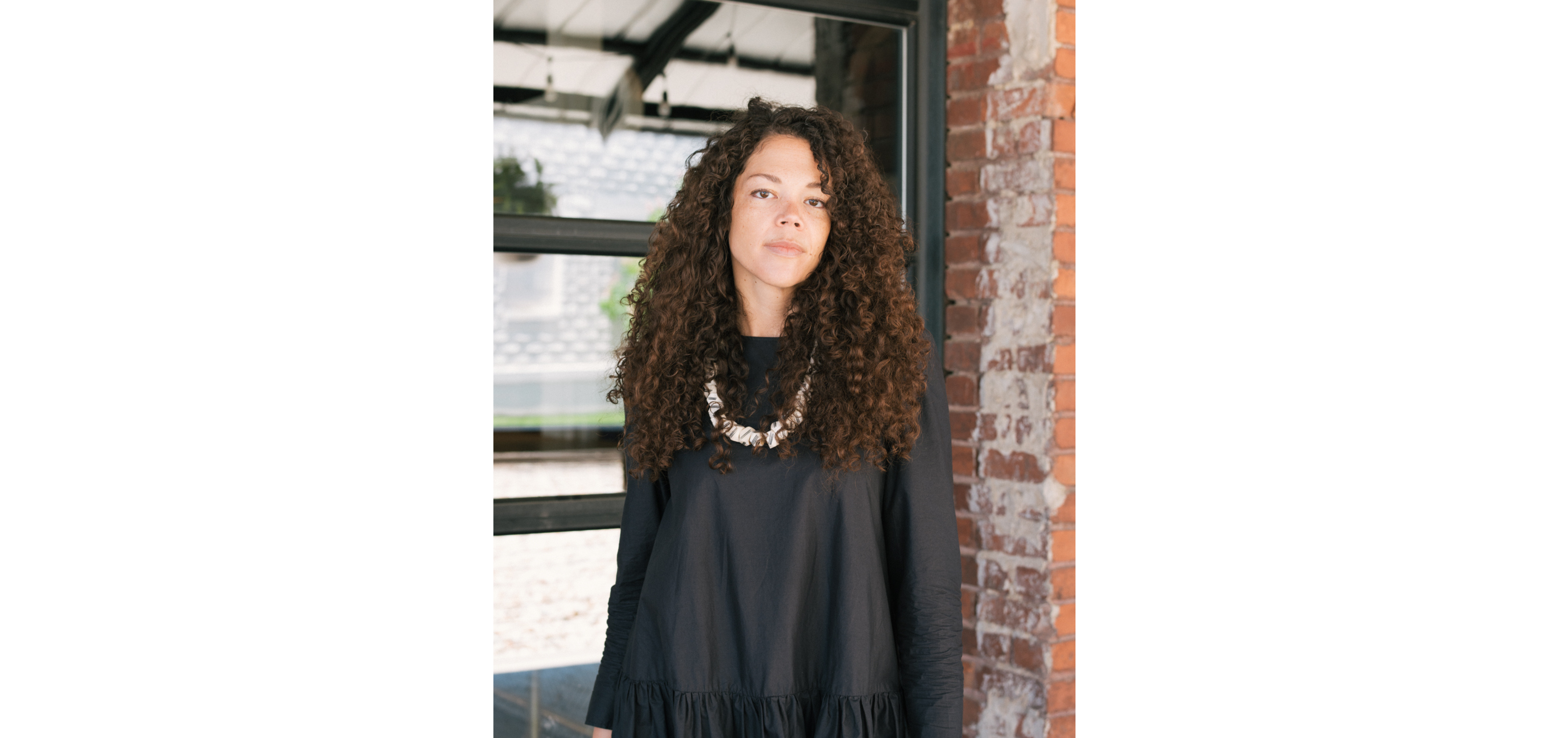
To reach Untitled Art, visitors first navigate a rite of passage: a promenade across the beach that leads into a tent pitched near the edge of the Atlantic. The curator of this year’s Special Project sector, Allison Glenn, relishes the strangeness of it. “You kind of slush through the sand, which is unstable, with the water right there,” says Glenn, who is also Artistic Director-at-Large of The Shepherd in Detroit and Curator of the 2026 Toronto Biennial of Art. “All of this seems so precarious…if you think about the way art is supposed to be viewed, it’s not supposed to be with water and salt, on sand.”
For Glenn, that sensory disruption isn't a flaw but a starting point. Her curatorial practice is rooted in an embodied experience of place, asking how specific sites shape meaning and movement. She brought that approach to "Promise, Witness, Remembrance," her much-acclaimed 2021 exhibition at the Speed Art Museum honoring Breonna Taylor, which was created in close collaboration with Taylor's mother after the young Black woman was killed by police in her Louisville apartment. Years earlier, Glenn had turned Chicago’s infrastructure into spaces for unexpected encounters with art with "off the wall," a public art project that took place across bus benches in 2014, developed while working at Monique Meloche Gallery.
"I'm always thinking about site, place, environment,” she says. “I often ask myself, how does my body feel in this space? It’s a question I want other people to get curious about,” she says. Non-traditional formats, she adds, “can allow for a more embodied experience of viewing.”
At Untitled Art, Miami Beach, Glenn has curated the fair’s largest Special Projects sector to date—18 ambitious, site-specific installations and projects. For the first time, the sector extends beyond the fair itself, with large-scale digital works appearing across Miami's mainland, in partnership with Orange Barrel Media. “The idea was for Special Projects to have a reach beyond the fair," Glenn says. "It makes it possible for anyone to see a select group of works in public space."
The Special Projects edition is conceived as a meditation on water in its many forms: from earthbound waterways to the Milky Way as a celestial river; coastal erosion and climate disaster; diaspora and migration; labor and the history of industry. Here, water is both a lifeline and an existential threat, ancestral memory and metaphor.
The digital program on show in Miami mainland and the fair includes new works by Cristina Molina—who contributes a five-channel piece tracing matrilineal histories in the American South, linking coastal erosion to the stories of her maternal family—and Kite (Oglála Lakȟóta), whose work explores the Lakota understanding of the Milky Way as Wakpá Iyóžaŋžaŋ, a river of light carrying loved ones home across the sky. Rather than a literal body of water, it is a process of bearing memory. Kite (Oglála Lakȟóta) creates scores meant to be sung, felt and held, linking indigenous knowledge systems, contemporary art and technology through the body, land, and cosmos.
“We have the terrestrial, the celestial, and the subterranean all happening in concert,” Glenn says of the section.
The first work visitors to the fair will encounter is a new commission by Mexico City-based duo Celeste. Entitled Cosmos (2025) and presented by JO-HS, the work is a vast suspended textile installation inspired by a flower native to central Mexico. Here, anchoring the fair’s entrance, the ancient bloom serves as a symbol of resilience, having so long endured. Glenn notes that the plant’s survival is tied to the movement of people, rain cycles, and migratory water patterns. “It’s about interdependence,” she says, “how water sustains it, and how it sustains us.”
If this work addresses the evolutionary effects of water scarcity, Detroit-based Scott Hocking looks instead at what its abundance can create—and take away—in his works, which bring maritime history from Detroit to the Floridian coast; his work at the fair is supported by Library Street Collective. These large-scale sculptures, made from salvaged materials from a former WWII-era marina in Detroit, remind viewers how water has transformed both land and labor.
Hocking is one of about seven Detroit artists in the sector (“you gotta represent,” Glenn says, laughing). Another is Tiff Massey, who presents a sculptural reimagining of Detroit’s Belle Isle as a sanctuary honoring water’s generational memory.
The scale of some of the works on show is part of Glenn’s commitment to making a section that feels physically different for viewers, including creating what she calls a “sculpture pavilion” (“because it sounds dramatic, and I like that kind of drama,” she quips), a dedicated space giving large-scale works room to breathe.
Glenn's commitment to Detroit runs deep—she grew up in the Great Lakes region, surrounded by lakes so vast they resemble oceans, spending formative years looking across to Canada. “I've always been surrounded by water,' she says. I lived in Chicago for almost 10 years. I did a project in Louisville, I worked on a biennial in New Orleans, and curated a triennial in St. Louis—give me a French port city and I'm happy. Now I live in the archipelago that is New York City.”
Another highlight is a sonic installation by Colombian artist Leonel Vázquez, whose vessels of water generate live acoustic frequencies. The work pays tribute to rivers that “now fall silent,” Glenn explains, an elegy for waterways altered or erased by environmental and industrial change, as well as conflict. The piece expands the sector’s geography even further, linking Miami to disappearing rivers across the Americas.
Her choice to foreground water is both lived experience and curatorial through-line: Glenn has given herself a two-year frame for this specific curatorial approach — an unusually disciplined way of working. “I just decided to give myself a frame,” she says, “to think thematically about global waterways for the next few years.”
This framework is underpinned by almost two decades of engagement with water-related theory, from the Drexciya myth to postcolonial and diasporic thinkers such as Césaire, whose work considers oceans as sites of rupture, memory, and migration. These ideas provide a conceptual spine for Glenn’s thinking, which is running concurrent with her curatorial appointment with the 2026 Toronto Biennial of Art, where she is reflecting on the foundation laid by the indigenous curators and advisors who shaped the inaugural edition of the Toronto Biennial, and delved into the city’s hidden waterways.
This gesture toward a broader curatorial lineage reflects Glenn’s approach of working within interwoven arcs rather than isolated moments. "I'm always trying to figure out how to share power," she says. "When you learn how to share it, anything is possible."
This philosophy informs her prioritization of female-led organizations in the sector, including Official Welcome (Los Angeles, CA), Other Plans Gallery (New Orleans, LA), JO-HS (Mexico City, MX / New York, NY), and Tulsa Artist Fellowship and Central Standard (Tulsa, OK), as well as the residency and non-profit incubator Buffalo Prescott (Detroit, MI).
"It's important to me to support and sustain the ecosystem. We've seen galleries closing at a terrifying rate. But there are also emerging galleries that have popped up in the past couple of years, and a lot of them are women-led, with different models," Glenn says. “And, as a woman who runs my own business, I understand what it means to go for it. Equitable practices in this field have always been part of the work I do and intrinsic to who I am."
This ethos also guides her inclusion of several artists in mid-career—a stage often marked by ambitious thinking but limited opportunities. One of them is L.A.-based Cameron Harvey. “She’s making some of the most important work of her career,” Glenn says. “To be able to champion that feels really good.”
Glenn has been studying emerging continental climate patterns—fires at the edges in California and Canada, and catastrophic flooding across the central United States, from Texas through the Midwest—and asked Harvey to consider how her work might respond to these shifts for her new commission developed for the 2026 Toronto Biennial. With this forthcoming series, Harvey will create new, large-scale paintings that reflect on the chaparral shrub—a plant that has learned to regenerate after California’s devastating fires. At Untitled Art, Harvey’s reflecting on coastal waterways, and the objects she found in nature while walking along the beach in California, including seaweed, leaves and shells. Using her body to move the pigment across three draped, shaped, unstretched canvases, Harvey pulls the viewer into relationship with the natural forms she echoes, and with their own physicality.
These works are a preview of a new commission of Harvey's that Glenn will include in the Toronto Biennial, opening September 26, 2026: Glenn has known Harvey for 14 years, and her decision to work with the artist across both projects speaks to her approach to curating. "The relationships are enduring no matter where they are," she says. "It's just a matter of how and where they fit."
Her approach to the Special Projects sector follows the same logic: a constellation of artists, ideas, and geographies held together not by spectacle, but by the slow work of attention.
Curating in such an exposed, unstable environment is both exhilarating and unnerving. “It’s exciting—and terrifying at the same time,” she says—a fitting paradox for a project that asks viewers to feel their own bodies on shifting sands.
Charlotte Burns is the founder of Studio Burns, which produces original projects including the documentary podcast "Hope & Dread: Tectonic Shifts in Power in Art" for Art& and "The Burns Halperin Report," a data study created in collaboration with artnet News editor Julia Halperin that tracks equity in art museums and the market. Burns was previously the Executive Editor of "In Other Words", a weekly newsletter and podcast. She is the former art market, news and business editor (Americas) for The Art Newspaper. Prior to that, she worked for galleries including Hauser & Wirth, and for the cultural communications firm Bolton & Quinn. She also ran special projects for Anthony d'Offay.